The Sunday standard
A perfect lawn isn’t luck. It’s a program.
Most lawns don’t need a miracle — they need someone who shows up with a plan. We test the soil, treat the weeds, evict the grubs, and cut the stripes, week after week, across Essex County. You get the morning back.
What’s eating your lawn
Four problems. All of them solvable.
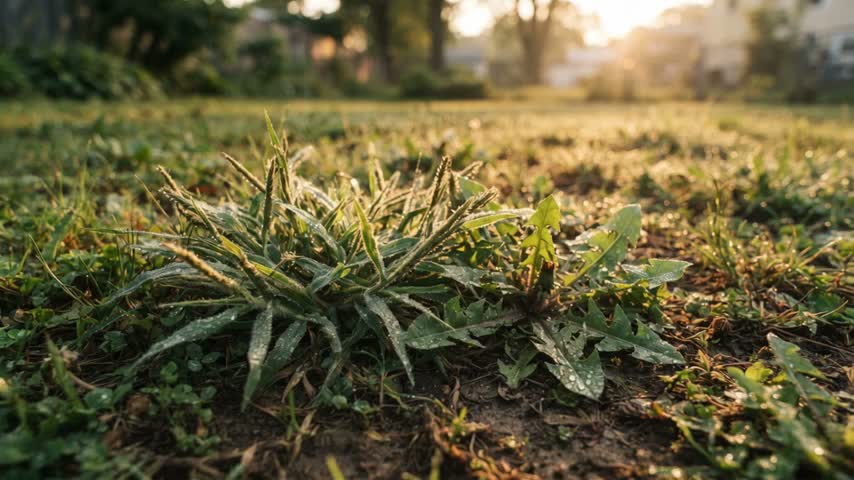
Weeds & crabgrass
They out-compete thin turf for light and water, and one plant becomes fifty by August.
Bare & thin patches
Foot traffic and compacted soil choke the roots until the grass simply gives up.
Brown spots & grubs
If the turf peels back like carpet, grubs are feeding underneath — and skunks know it.
Moss & shady corners
Moss wins where soil is sour and compacted. Scraping it off changes nothing.
The program
Everything a lawn needs, on one schedule.
We pull cores from six to eight spots so one bad corner doesn’t speak for the whole yard, and send them out for pH, organic matter, phosphorus and potassium.
On the first visit, before anything gets spread. Re-tested every third season, or sooner if a section stops responding to feeding.
The lab sheet, in plain English. Most Essex County soil runs acid — under 6.2 and lime goes down in fall, when it has the winter to work in.
Five feedings: pre-emergent and starter in early spring, a late spring round, slow-release through summer heat, early fall, and a winterizer once growth stops.
Crabgrass pre-emergent goes down when soil holds 55°F, usually around forsythia bloom. Miss that window by two weeks and you spend the summer chasing it.
Dandelion, clover, plantain and violet get spot-treated where they stand. We don’t blanket-spray a lawn that only has weeds in the strip by the driveway.
Core aeration pulls plugs two to three inches deep and leaves them on top to break down. Seed goes into the open holes the same day, while they’re still soft.
Late August into September. Fall seed roots before frost and comes back ahead of the crabgrass; spring seed spends its whole life losing that race.
Turf-type tall fescue for the sun and traffic, a bluegrass blend where it’s irrigated, fine fescue under the maples. You get a watering schedule for the first three weeks.
Preventive treatment goes down before the eggs hatch, so the grubs never get big enough to cut roots. If turf is already peeling back like carpet, we treat curatively and feed the recovery.
June through early July for prevention. Damage usually shows up in August — by then you’re repairing, not preventing, so the timing matters more than the product.
Surface feeders that get blamed on drought: chinch bugs along hot sidewalk edges, sod webworm, and the skunks that dig once they smell what’s underneath.
Same day every week: mow, string trim, edge the walks and drive, blow the hard surfaces clean. Clippings get mulched back in unless the grass got away from us.
Three and a half to four inches through summer — tall grass shades out weed seed and keeps the roots cool. Blades sharpened weekly, because a dull blade tears the tip and browns it.
Direction alternates every visit. It keeps the blades from leaning one way all season, and it’s the part your neighbors actually notice.
Where we work
Twenty minutes from the truck, most days.
Montclair · Glen Ridge · Bloomfield · West Orange · Maplewood · South Orange · Millburn · Short Hills · Livingston · Verona · Cedar Grove · The Caldwells · Roseland · Essex Fells · Fairfield · Nutley · Belleville · The Oranges · Irvington
Your town not listed? Ask — if it borders Essex County, we probably mow there.
Reviews
What the neighbors say.
“They found grubs before I knew what I was looking at. The strip along the driveway came back that same fall.”
Dana R.Glen Ridge · customer since 2023
“Third company in four years. First one that handed me a soil test instead of a sales sheet.”
Mike C.West Orange · customer since 2024
“Same day every week, and they text when rain moves them. I stopped thinking about it, which was the point.”
Priya S.Maplewood · customer since 2022
Most of our route came from someone’s neighbor asking who cut that.
Free estimate
Hand us the hard part.
Tell us your town and what your lawn is doing. We walk the property, test the soil, and send a plan with real numbers — usually within two days.
(973) 555-0142Consider it handled.
We’ll call you back within one business day to walk the property.